
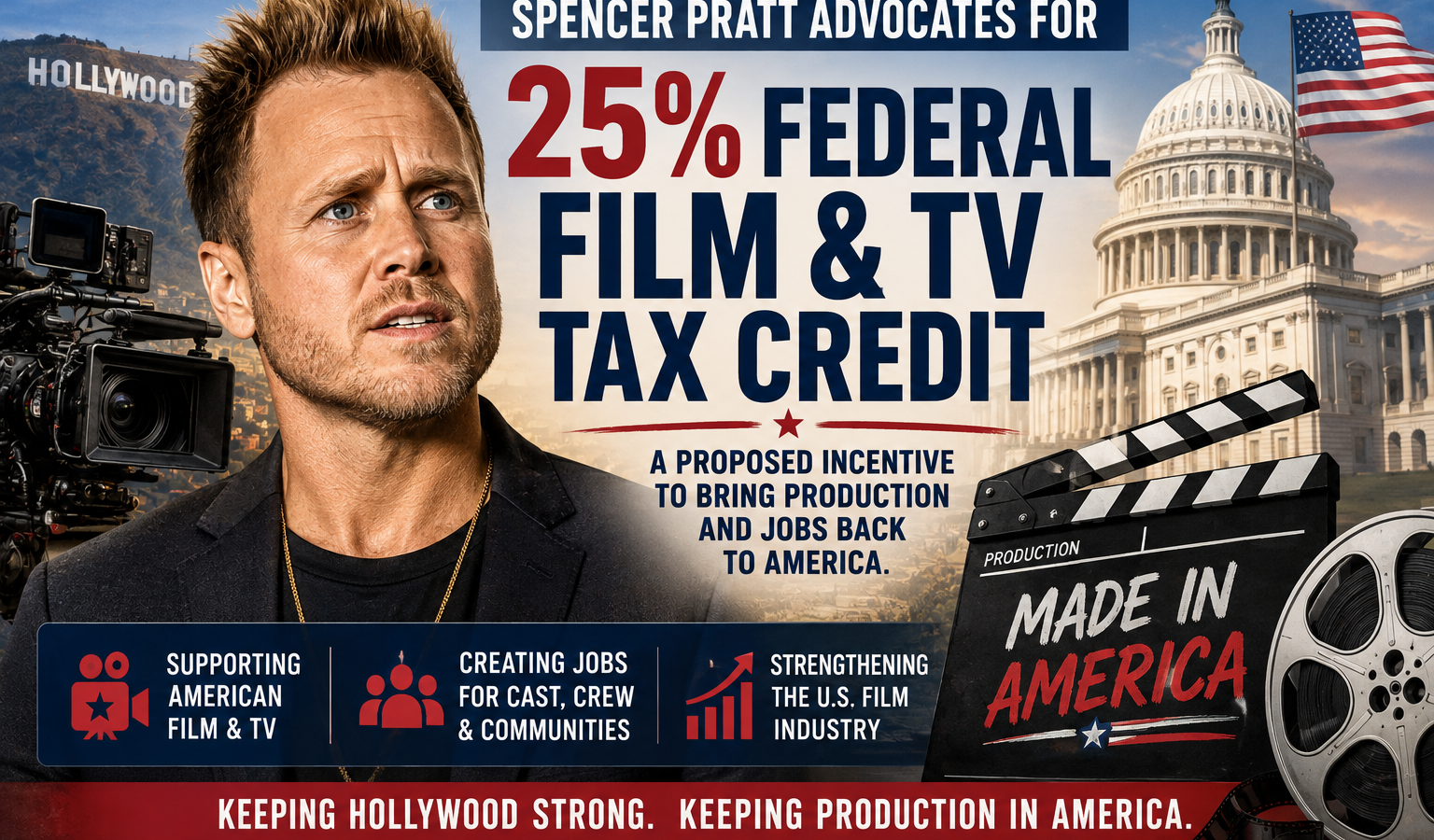
Former Los Angeles mayoral candidate Spencer Pratt says he is working with President Donald Trump on a proposed federal incentive designed to encourage film and television production in the United States.
Spencer Pratt is taking on a new role in Hollywood’s ongoing battle over production incentives.
The reality television personality and former Los Angeles mayoral candidate says he is working with President Donald Trump on a proposed 25% federal film and television tax credit, an initiative Pratt says could help bring more entertainment production and jobs back to the United States.
Pratt announced the effort on social media after meeting with Trump in California. According to his post, the goal is to create a federal incentive that would make producing movies and television programs domestically more competitive with international production destinations. (Hollywood Reporter)
Pratt Enters the Film Incentive Debate
The push puts Pratt into a much larger conversation surrounding the future of American film and television production.
For years, U.S. productions have faced competition from countries and regions offering substantial financial incentives to filmmakers. States including Georgia, New Mexico, New York and California have developed their own programs, while international markets have increasingly competed for major studio and independent productions.
Federal supporters of a national incentive argue that a U.S.-wide program could make domestic production more competitive and encourage studios to spend more of their budgets on American workers and businesses.
Pratt’s proposal centers on a 25% federal tax credit, although the precise structure of the program he is advocating for has not yet been publicly detailed. It is also unclear whether his proposal is identical to the federal incentive legislation being developed and promoted by other industry advocates and lawmakers. (Northeast Times)
A Broader Hollywood Push for Federal Incentives
Pratt is not alone in calling for federal action.
Entertainment-industry organizations, labor groups and political advocates have been pushing for a national production incentive as Hollywood faces increasing competition from overseas markets and states offering aggressive production programs.
The current movement includes support from figures associated with the entertainment industry as well as members of Congress from both parties. Sen. Adam Schiff has been among the lawmakers advocating for a federal film and television incentive, while Reps. Laura Friedman and Brian Jack have also emerged as supporters of federal legislation. (Northeast Times)
The goal shared by many of the advocates is straightforward: make the United States a more attractive place to shoot and produce movies and television.
Why Film Tax Credits Matter to Producers
For producers, production incentives can have a major effect on where a project is ultimately filmed.
A tax credit can reduce a production’s effective cost by providing a financial benefit based on qualifying expenditures, wages or other eligible costs. Programs vary considerably from one jurisdiction to another, with some incentives structured as refundable or transferable credits and others using rebates or grants.
That competition can influence production decisions long before cameras begin rolling.
A project may compare multiple locations based on labor availability, infrastructure, studio facilities, locations, permitting and the financial incentives available in each market.
For independent filmmakers operating with tighter budgets, the incentive can be particularly important because even relatively modest savings can potentially be redirected toward cast, crew, locations, visual effects, post-production or marketing.
Could a Federal Incentive Change Hollywood Production?
The central question is whether a national tax credit could reverse some of the production migration that has taken place over the past several years.
Supporters believe a federal program could complement existing state incentives and make producing in the United States more financially attractive.
Critics of film incentives, however, have historically questioned whether the economic benefits justify the cost of government subsidies. State and federal policymakers have debated whether production incentives generate enough jobs, spending and tax revenue to offset their expense.
That debate is likely to continue if Congress considers a major federal program.
For producers, however, the issue is increasingly practical: where can a production be made most efficiently while maintaining access to qualified crews, facilities and locations?
Pratt’s Unusual Path Into Hollywood Advocacy
Pratt’s involvement gives the issue an unexpected new public advocate.
Best known for appearing on MTV’s The Hills, Pratt later became involved in Los Angeles politics and ran for mayor. His political profile also brought him into Trump’s orbit.
His latest effort shifts that attention toward the entertainment business.
Pratt has argued that bringing production back to the United States could help restore entertainment-industry employment and strengthen Hollywood’s position as a global production center.
Whether his involvement develops into a formal lobbying effort or legislative proposal remains to be seen.
What Happens Next?
The biggest unanswered question is whether the proposed 25% federal film and television tax credit will become actual legislation.
At this stage, Pratt has publicly described his discussions with Trump, but the White House has not formally announced a new federal film incentive program. The details of Pratt’s proposal—including eligibility requirements, qualifying expenditures, annual limits and how the credit would interact with existing state incentives—have not been fully disclosed. (Northeast Times)
That leaves the proposal in its early stages.
Still, the renewed attention comes at a critical moment for the American entertainment industry. With production incentives increasingly influencing where movies and television shows are made, the question of whether the federal government should participate in that competition is becoming increasingly difficult for policymakers and industry leaders to ignore.
For Hollywood producers, studios, independent filmmakers and thousands of production workers, the outcome could have significant consequences.
If a federal film and television tax credit ultimately becomes reality, it could reshape the economics of where American movies and television shows are produced—and potentially put the United States in a stronger position to compete for productions currently heading overseas.
This story will be updated as additional details about the proposed federal film and television tax incentive become available.
Working in production? List your crew profile, location, or open job free on Film-Friendly.
Add Your Listing — Free